The Quiet Half-Hour: Turning a Hank into a Working Yarn
There is a particular sort of quiet that arrives when a hank of yarn lands on the table. The kettle has gone on. The needles are nearby but not yet needed. The yarn is still a loop, a twist, a length of possibility. Before it becomes a jumper, a hat or a pair of mittens, it has to become something a knitter can actually work with: a cake, a ball, a manageable form that will feed the needles without sulking.
Winding is often treated as a chore between buying yarn and casting on. I would like to make a small case for the opposite. Done with a little care, it is not a delay. It is the first act of attention you give the project.
A Hank Is a Promise, Not a Working Ball
A hank, or skein, is usually a long loop of yarn, twisted and tied so it travels home safely. It looks neat hanging in a shop or photographed on a wooden table, but it is not designed to be knitted straight from the loop unless you enjoy living dangerously. Left to its own devices, a hank will tangle. It will find the one loose end and make a nest of it. This is not malice. It is simply the nature of a long piece of yarn with nowhere to go.
Turning that loop into a cake or ball gives the yarn a shape that suits the work. It also gives you a chance to meet the yarn properly: to feel its twist, spot any thin places, notice the joins, and understand how it behaves. You are not just preparing the yarn. You are preparing yourself.
Tension Begins at the Winder
A common surprise in knitting is not the pattern, but the yarn cake that collapses halfway through a row, or the skein that feels tighter after winding than it did in the shop. Both usually come down to tension at the winding stage. Wind too tightly and you stretch the yarn, especially if it is a soft wool or a singles yarn. Wind too loosely and the cake slumps, snags and makes a mess of your centre-pull.
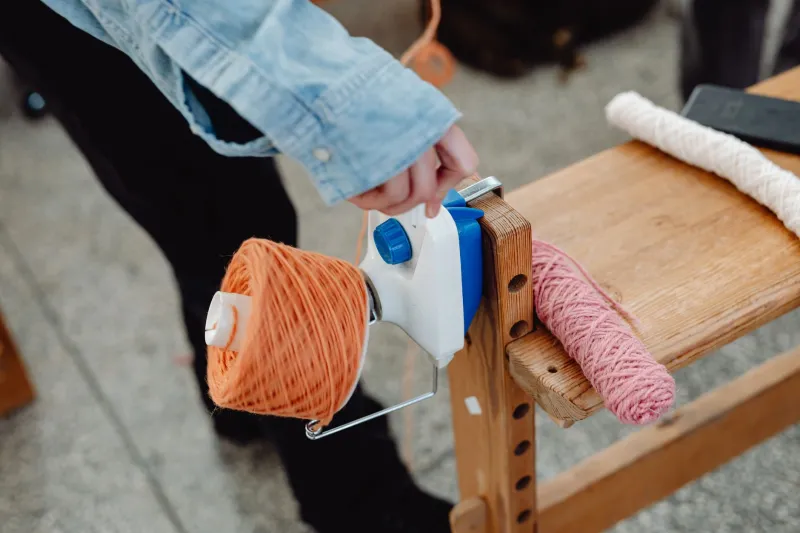
The aim is a gentle, even tension. If you are using a swift and winder, let the swift turn freely and guide the yarn rather than pulling it. Your hand should be a steward, not a brake. If you are winding by hand around a chair back or your knees, keep the loops relaxed and move the ball around as it grows so the yarn does not stack in one tight tower.
This is also the moment to notice things. A knot that appears while winding is a gift compared with a knot that appears in row 87. A weak spot can be dealt with now. A skein that has been wound too tightly by a shop winder can be re-wound at home with a lighter hand. None of this is fuss. It is just good manners to the yarn.
Shop-Winding Etiquette: Ask, Don’t Assume
Many UK yarn shops have a swift and winder behind the counter, and many will happily wind your purchase for you. Some offer it free with a purchase, some charge a small fee, and some prefer to wind only yarn bought in the shop. None of these policies are unreasonable. The key is to ask before you assume.
If the shop is busy, wait your turn. Do not reach behind the counter to help yourself to the winder, however tempting it looks. If you have brought a skein from home or from another shop, ask whether they are happy to wind it. Be equally happy if the answer is no. A quick please and thank you goes a long way, and a shop that feels respected is more likely to be generous with its time.
If you are winding at home, a swift and winder is a lovely thing to own, but it is not essential. A chair back, a patient friend and a pair of hands will do. The ritual is not in the equipment. It is in the pause.
What to Check Before the First Stitch
Once the yarn is in a cake or ball, give it a quick once-over before you cast on. Check the ball band for dye lot, fibre content and yardage, and keep it somewhere sensible. If you are working from a partial skein, weigh it if you can, or at least make a note of what you have. Check for breaks, thin spots, felting, moth damage or any damp smell. Give the yarn a gentle feel for anything that suggests it has been stored badly.
As you wind, let your fingers run along the strand. You will soon notice if the twist is tight, if the yarn is splitty, or if there is a join coming. If you find a knot, decide now whether to cut and rejoin or work around it. Better to make that decision at the table than mid-row with a cup of tea going cold.
A cake that collapses is not a moral failing. It is information. Re-wind it more loosely. A skein that tangles is not a sign that you are bad at this. It is a sign that the yarn needed a slower pair of hands. Winding is a skill, and like all skills, it improves with practice.
Make It a Small Ceremony
Put the phone away. Clear a little space. Make the tea. If you have a swift, listen to its soft click. If you are winding by hand, enjoy the rhythm of the loop passing through your fingers. This is not wasted knitting time. It is knitting time before the knitting, the moment when the project moves from idea to actual fibre in your hands.
There is a tactile pleasure in watching a hank become a cake: the shape changing, the yarn settling, the colours lining up in a way they never quite do in the shop. It is a small, ordinary act, but it sets the tone. A knitter who winds with care tends to knit with care. The yarn notices. So do you.
So before the first stitch, give the yarn its quiet half-hour. The pattern can wait. The kettle is already on.