Steam and Strands: A Beginner's Fair Isle on a Humble Hot Water Bottle

Photo: John St Helier Lander, Public domain, via Wikimedia Commons
There is a particular kind of November evening when the radiators have gone lukewarm and the kettle is doing more work than the heating. That is when a hot water bottle stops being a novelty and starts being essential. It is also, I have come to believe, the perfect first Fair Isle project: a small, warm canvas that asks you to learn stranded colourwork without demanding a whole jumper's worth of commitment.
I came to this conclusion after years of teaching friends to knit. Every autumn, someone would announce that this was the year they would tackle Fair Isle. They would buy a jumper's quantity of yarn, print a chart, and then stall somewhere around the second repeat, convinced that their tension was ruined and their floats were a disaster. The problem was rarely the knitter. It was the scale. A jumper is a long conversation with your mistakes. A hot water bottle cover is a short, forgiving chat.
Why a Hot Water Bottle, of All Things
A hot water bottle cover is a tube. That is the first mercy. You cast on, join in the round, and work a simple cylinder of stocking stitch with a colour pattern running through it. There is no armhole shaping, no sleeve to set in, no neckline to fret over. You are not trying to fit a human body with all its slopes and angles. You are trying to fit a rubber bottle, which is a far more reasonable shape.
The second mercy is that the finished object is useful. A swatch lives in a drawer. A hot water bottle cover lives on the sofa, in the bed, under a blanket on a cold night. You will see it every day from October to March. That daily use is a quiet kind of feedback: the cover that pills slightly at the base, the float that pulls a little tight across the middle, the colour combination that looked better in the skein than on the bottle. You learn from a thing you actually use.
And the third mercy is scale. A cover takes a few evenings, not a few months. You can finish a first Fair Isle before the cold really sets in. That matters more than it sounds. Confidence is built by finishing.
Choosing Two or Three British Shades
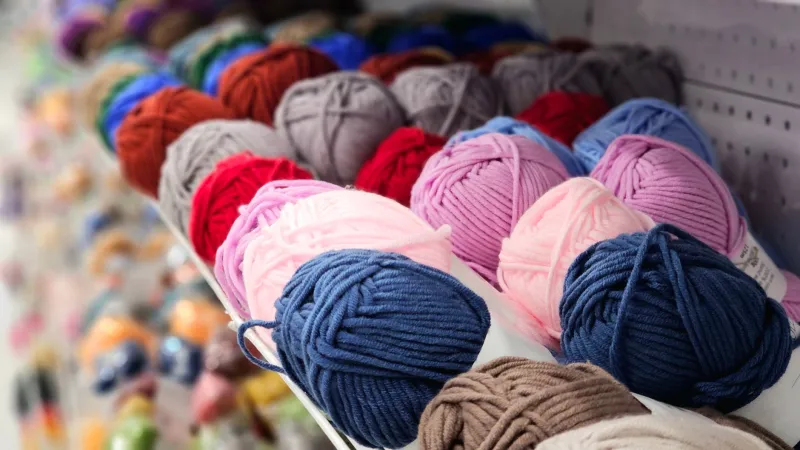
You do not need a rainbow. Two shades will teach you everything you need to know about carrying yarn, reading a chart and keeping your floats even. Three gives you a little more room to play with a border or a simple repeating motif. Any more than that and you are adding decisions, not skills.
Start with a light and a dark. A natural undyed cream against a deep moorland green, a soft oatmeal against a rusty brown, a pale grey against a navy — these pairings are classic for a reason. They show the pattern clearly. If you want a third shade, choose something that sits between the two in value, not something that fights them. A muted blue or a faded pink can act as a bridge without turning the cover into a fairground.
British wool is a good companion for a first colourwork project. A Bluefaced Leicester or a soft Shetland-style yarn has enough bounce to hide minor inconsistencies and enough grip to hold the stitches where you put them. A sturdy Wensleydale or a blend with a little more tooth will give you crisp stitch definition, which is satisfying when you are learning. Avoid anything too slippery or too loosely spun; it will make your floats wander and your tension harder to read.
Buy a little more than you think you need. Not because the pattern demands it, but because colourwork eats yarn in ways that plain stocking stitch does not. Floats add bulk at the back of the work, and a tight float can use more than you expect. A spare ball also means you can swatch without panic.
Tension, the Quiet Teacher
Here is the honest bit: your first Fair Isle tension will not be perfect. It will probably be a little tighter in the patterned rounds than in the plain ones. This is normal. The trick is not to fight it but to manage it.
Go up a needle size for the colourwork section if you need to. Many knitters do. The floats at the back of the work take up space, and a slightly larger needle gives them room to breathe. Keep your floats loose — really loose. A good rule of thumb is that the float should sit comfortably across the back of the work without pulling the stitches in. If you can see the fabric puckering, your floats are too tight.
Spread your stitches on the needle as you work. This is the single most useful habit I know for stranded colourwork. Every few stitches, push the stitches along the cable or the circular needle so they are not bunched up. It helps you see the fabric forming and stops the floats from cinching in.
And swatch in the round if you can. A flat swatch lies to you about colourwork. You can knit a small tube on circular needles, or use the trick of knitting a flat swatch with the yarn carried loosely across the back of every other row. Either way, you will learn more about your tension from a tube than from a square.
Working in the Round Without the Fear of Steeks
A hot water bottle cover can be entirely steek-free. That means no cutting. No scissors near your stitches. No holding your breath while you reinforce a column of stitches and then slice through your own work.
Instead, you knit a tube. When you reach the point where the bottle needs an opening, you can work back and forth for a few rows to create a simple flap, or you can divide the stitches and knit a small button band. A basic cover can be as simple as a tube with a ribbed top and a gap for the neck of the bottle, finished with a couple of buttons or a short tie. If you want a cleaner finish, you can graft the base closed with Kitchener stitch, or seam it with a simple mattress stitch. Neither requires anything more advanced than patience.
The point is that you are learning the colourwork, not the engineering. Steeking is a wonderful skill, but it is a separate skill. Save it for a later project, when you already trust your floats and your tension. Your first Fair Isle deserves to be a gentle introduction, not a test of nerve.
The Finish Line Is a Warm Bed
When you finish, you will have a small, slightly imperfect, deeply useful thing. You will also have a record of your learning: the round where your tension shifted, the motif where you finally got the hang of carrying two yarns, the border where the colours sang. That record is more valuable than a perfect swatch, because it is attached to something you will actually use.
A hot water bottle cover is not a lesser project. It is a small, warm canvas. It asks you to practice honestly, to make mistakes quietly, and to finish something before the cold sets in. And on a November night, when the heating has gone off and the kettle is on, you will pull it out of the airing cupboard and feel the quiet confidence of a first Fair Isle that is already earning its keep.