A Square of Wool, a Wealth of Knowing: Why Shop-Floor Expertise Deserves Paying For

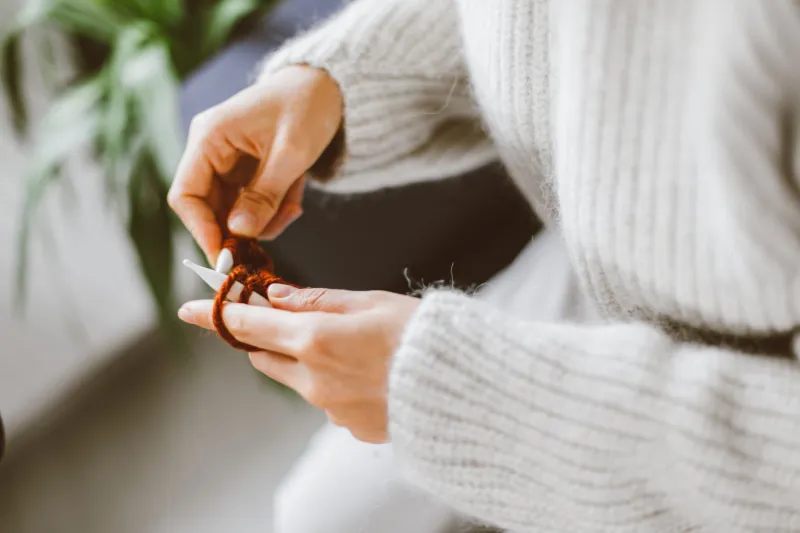
Photo: independent UK yarn shop interior with wooden table, skeins of wool and a knitter making a tension swatch, via nfil.net
The rain was doing that November thing — not quite falling, just hanging in the air — when I pushed open the door of my local yarn shop. I had two skeins in mind and no real plan: a soft green for a jumper, maybe, or a quieter grey-green that would go with everything. The owner was winding a skein behind the counter, a mug going cold beside the till. She looked up, smiled, and asked the question that would eat the next hour: 'Have you swatched them?'
I hadn't. Of course I hadn't. I had squashed both skeins against my cheek, held them under the window light, and decided that was close enough. It was not close enough.
A Saturday at the Counter
What followed was not a hard sell. It was a masterclass disguised as a chat. Out came a pair of needles, a notebook, and a little basket of odds and ends. We wound off enough for two tension squares, one in each colour. The owner talked me through the fibre content, the twist, how the yarn might grow after blocking, and why the greener skein was likely to pool in a way I might love or loathe depending on the jumper. She showed me a sample from a finished garment on the wall — same yarn, different dye lot, slightly different mood. Then she left me to knit, checked in twice, and made me a cup of tea I did not ask for.
By the time I left, I had two damp squares drying on a towel, a much clearer idea of which colour suited my skin, and no yarn in a bag. I had spent nearly an hour of her Saturday. I had used her needles, her space, her heating, her tea, and a small amount of her stock. And I had paid for none of it.
That is not a criticism of her. It is a criticism of how easily I had come to expect it.
What the Little Square Holds
A swatch looks like nothing much: a bit of knitting, a few rows, a slightly wobbly edge. But behind that square sits a stack of invisible work. There is the cost of the sample yarn, the time spent winding and knitting, the knowledge of how different fibres behave, and the patience to explain it all again to the next person who walks in. There is also the rent, the rates, the lighting, the heating, and the quiet labour of keeping a shop open on a wet Saturday when the high street is half-empty.
We do not usually put a price on that. We call it advice, or a friendly service, or part of the shopping experience. And in many shops, it genuinely is offered freely — a gift of time from people who love the craft and want you to love it too. But free is not the same as costless. The shop still pays for every hour behind the counter, even when no till rings.
I am not arguing that every question should come with an invoice. That would make yarn shops feel like call centres, and the warmth would go out of them. What I am arguing is that we should stop treating expertise as a free extra that comes bundled with a browse. The swatch is not free. It is labour, generously given. And generous things deserve to be met with generosity.
The Cost of Quiet Troubleshooting
There is a particular kind of shop-floor work that never shows up on a receipt. It is the quiet troubleshooting: the dropped stitch rescued at the counter, the sleeve that needs a second opinion, the colour question that takes three skeins and a mirror to answer. It is the owner saying, 'Bring it in and we will look at it together,' when she knows perfectly well that the looking will take twenty minutes and may end with no sale at all.
This work matters. It is part of why bricks-and-mortar yarn shops still exist in a world of online carts and next-day delivery. You cannot squish a screen. You cannot ask a website whether the red will clash with your winter coat. You cannot learn from a product page in the same way you learn from a person who has knitted the pattern, dyed the yarn, or spent years watching makers make mistakes and then unmake them.
But that kind of shop is not a public service. It is a small business, often run by one or two people who are already doing the work of buying, pricing, displaying, posting, teaching and bookkeeping. If we value the advice, we have to value the conditions that make it possible.
Support Without a Guilt Trip
The good news is that supporting a local yarn shop does not have to mean buying something every single time you walk through the door. It also does not have to mean spending more than you can afford. Fair exchange is not about guilt. It is about recognising where value sits and choosing, when we can, to put something back.
Here are a few practical ways to do that without turning every visit into a transaction:
- If you have used the shop's advice to choose a project, buy the yarn for that project there if your budget allows. If a whole jumper is out of reach, buy a single skein, a pattern, or a gift card.
- Book and pay for the things that take real time: workshops, colour clinics, finishing classes, knit-alongs, or a one-to-one consultation if the shop offers one.
- Ask before you settle in for a long question. A quick call ahead can save everyone's Saturday, and it signals that you respect the shop's diary.
- Buy the pattern through the shop when you can. It is a small thing, but it keeps the till moving and shows that you value the curated shelf, not just the free advice.
- Leave an honest review, recommend the shop to a friend, or bring a new knitter along to a paid class. Word of mouth is still the best marketing a small shop has.
- If you must buy online for a particular reason, be honest about it. Many owners would rather have a transparent conversation than feel like the shop is being used as a free showroom.
- Remember the small kindnesses: a thank-you card, a biscuit for the communal table, a message when a workshop helped you finish something. These do not pay the rent, but they do sustain the relationship.
None of this is about policing anyone's spending. Yarn budgets are real, and nobody should feel shamed out of a shop because they are browsing rather than buying. The point is simply to notice the exchange that is already happening. A Saturday hour of expertise is not nothing. It is a piece of someone's working life.
A Fair Exchange
I went back the following week and bought the grey-green. I also booked onto a finishing workshop I did not strictly need, because I wanted to pay for the kind of help I had received. The owner laughed when I said the swatch had made the decision for me. She said that was the whole point.
I still have the two little squares in my project bag. One is slightly tighter than the other. One has a wonky edge where I lost concentration. They are not beautiful objects, exactly, but they are useful ones. And they remind me of something worth keeping: the knowledge in a yarn shop is not a free sample. It is the heart of the place. The least we can do is treat it as though it matters — with our custom when we can, our respect when we cannot, and our thanks either way.