Forty Grams Short of a Sleeve: Why the Kitchen Scale Deserves a Place Beside Your Needles
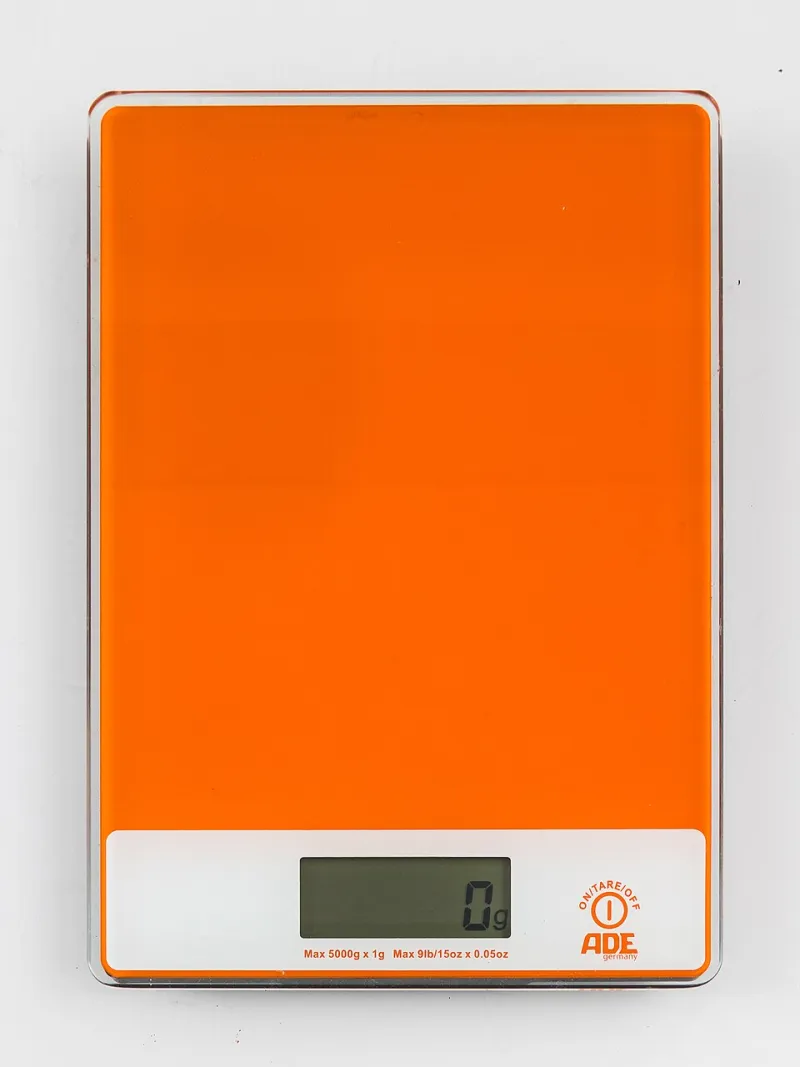
Photo: Raimond Spekking, CC BY-SA 4.0, via Wikimedia Commons
The moment usually arrives in early December. One sleeve is done and blocked. There is a bag of leftover yarn on the sofa that looks, by eye, like it might be enough. You knit the second sleeve faster than the first, hoping, and somewhere around the cuff ribbing the ball runs out and the whole jumper sits on a chair for three weeks waiting for a dye lot that no longer exists.
Almost every knitter has done this. Almost none of them needed to. The solution is sitting in a kitchen drawer, cost about a tenner, and is far more honest about your yarn than you are.
What a label can and cannot tell you
A ball band tells you the weight and the metreage at the point of manufacture. It does not tell you how much is left after you have knitted a back, half a front and a miscounted armhole. It cannot tell you that your gauge is looser than the designer's, which means your jumper is quietly eating 15 per cent more yarn per row than the pattern assumed.
A digital kitchen scale with 1g increments tells you both, in about four seconds. That is the whole pitch. It is not a gadget, it is a second opinion.
The one habit worth building
Weigh your yarn at the start of a project, and write the number down. Weigh what is left when you bind off, and write that down too. Weigh the finished garment. Weigh a single sleeve before you join it.
That is it. Do this for four or five projects and you will build a small private dataset more useful than any generic yardage chart, because it describes your hands, at your gauge, with your favourite yarn.
Weighing a swatch to forecast a jumper
Here is the method that repays the most effort. Knit a swatch a little larger than 10cm square, wash and block it exactly as you will wash the finished garment, then measure your true 10cm and cut out a 10cm × 10cm square of paper to lay over it as a guide. Weigh the area that represents 100cm².
Say your 4ply swatch weighs 3.5g per 100cm². An adult jumper in that gauge might represent roughly 9,000cm² of knitted fabric once body and sleeves are counted. That is about 315g — which lands neatly against the 300–400g that most adult 4ply jumpers actually consume, and against the three or four 100g skeins the pattern probably asked for.
The point is not precision. The point is the sanity check. If the designer asks for 500g of a yarn you have always found generous, you now have a reason to buy 400g and keep the difference in your pocket.
The second-sleeve question, answered in grams
Weigh the first sleeve once it is finished and blocked. Say it comes to 62g. Weigh your remaining yarn: 85g. You are fine, comfortably, and you can stop knitting with held breath.
If the sums come out the other way — 62g sleeve, 45g remaining — you know in January rather than on Christmas Eve, when there is still time to order a contrast colour for the cuffs, or to shorten the sleeve, or to accept an intentional-looking three-quarter length. Information at the right moment is worth more than yarn.
A note on UK skein sizes
British yarn comes in a slightly confusing spread of weights. Fifty-gram balls are still standard for a lot of Yorkshire-spun 4ply and for classic coned machine yarns. A hundred-gram skein is the indie-dyer's default. Mini skeins turn up at 20g and 25g, and jumper quantities are often sold in 500g cones.
It is worth knowing that a 100g skein that weighs 97g is normal — wool takes up and gives off moisture with the weather — and that this matters much less than knowing what your own last jumper actually used. Weigh a fresh skein as a baseline, and record the true figure rather than the printed one.
What to write in the notebook
For every project: yarn name and dyer, dye lot, stated weight and metreage, your gauge after washing, grams started with, grams used, grams left, needle size, and one line about how it washed. Tape a short length of the yarn to the page if you are the sort of person who enjoys that.
Future-you will open that notebook in two years, holding a single orphan skein, and will be extremely grateful to past-you for the two numbers that say whether it is a hat's worth or half a mitten's.
The scale as a shopping brake
This is the quietly radical part. Once your whole stash is weighed and recorded — an afternoon's work with a notebook, a scale and a strong cup of tea — you discover things. You discover that you have 480g of a decent grey DK, which is a jumper, and therefore that the fourth skein you were about to buy is not a jumper, it is another 100g of guilt.
Buying less starts with knowing what you already have, and weight is a far better measure of that than volume. A drawer that looks full might be four partial balls and a lot of air.
Buying the thing
Any digital kitchen scale that reads in 1g increments will do. Check it against a sealed bag of flour or a calibration weight once in a while. Put a bowl on top, tare it, and keep the bowl for yarn only. Ten pounds, no batteries to speak of, no app, no subscription, and it will outlast several jumpers.
We do not often get to make our knitting more certain for the price of two coffees. Take the win.